Camping Gear Odor Control: What Actually Works (And What Just Hides the Problem)
From activated charcoal to ozone machines, campers try many methods to control musty tent and sleeping bag odors. But most solutions either absorb, mask, or temporarily suppress odor without stopping the cycle. Here’s how each method works — and where they fall short.
Why Camping Gear Odor Is So Persistent
Before evaluating solutions, we must understand the problem:
Camping gear odors originate from:
- Residual organic material
- Microbial metabolism
- Moisture cycling
- Airborne volatile compounds (VOCs & mVOCs)
- Confined storage environments
Odor is not just “dirt.”

It is a chemical system operating in:
- Fabric fibers
- Plastic bins
- Sealed gear bags
- Confined storage air
If the airspace is untreated, odor will redevelop.
Evaluating Common Odor Control Methods
Let’s examine the most common approaches campers use.
1. Activated Charcoal
Mechanism: Adsorption (surface binding of molecules)
Activated charcoal:
- Has high surface area.
- Binds some odor molecules.
- Reduces humidity slightly.
Strengths:
- Non-damaging to fabric.
- Passive and simple.
- No fragrance.
Limitations:
- Does not chemically alter odor molecules.
- Saturates over time.
- Cannot oxidize sulfur compounds effectively.
- Ineffective in high-humidity cycling environments.

It absorbs — it does not neutralize.
Once saturated, odor returns.
2. Baking Soda
Mechanism: Mild base that neutralizes some acidic compounds
Strengths:
- Inexpensive.
- Safe for short-term use.
Limitations:
- Works only on certain acid-based odors.
- Ineffective against sulfur compounds.
- Does not address microbial VOCs.
- Offers no airspace protection during storage.
Best used for refrigerators — not seasonal tent storage.
3. Bleach & Hydrogen Peroxide
Mechanism: Surface-level oxidation
Strengths:
- Kills microbes on contact.
- Strong oxidizers.

Limitations:
- Damages fabrics.
- Weakens stitching.
- Fades colors.
- Degrades waterproof coatings.
- Unsafe for repeated gear treatment.
These are surface disinfectants — not airspace control solutions.
They cannot protect gear during sealed storage.
4. Ozone Machines
Mechanism: Aggressive oxidation of organic molecules
Strengths:
- Effective in professional remediation settings.
- Penetrates enclosed spaces.
Limitations:
- Requires power.
- Cannot be used while occupied.
- Degrades rubber and elastics.
- Harsh on technical fabrics.
- Impractical for seasonal tent storage.
- Expensive.
Ozone is a shock treatment — not a passive storage solution.
5. Air Fresheners & Scent Sachets
Mechanism: Masking through fragrance overlay
Strengths:
- Immediate scent improvement.
- Easy to deploy.

Limitations:
- Do not remove odor molecules.
- Layer fragrance over microbial VOCs.
- Can embed additional compounds into fabric.
- Fade over time.
Masking is not neutralization.
Often it creates a more complex, layered odor.
6. Essential Oils
Mechanism: Fragrance + mild antimicrobial effect
Strengths:
- Natural appeal.
- Pleasant short-term scent.
Limitations:
- Do not oxidize sulfur compounds.
- Can stain fabric.
- Can irritate sensitive users.
- Evaporate quickly.
- Do not prevent recontamination.
They improve perception — not chemistry.
The Missing Piece in Most Methods
Almost every common solution:
- Addresses surfaces.
- Addresses moisture.
- Addresses scent.
Very few address:
Airborne odor molecules in confined storage.
And that’s where the real cycle occurs.
The Storage Airspace Problem
When camping gear is stored:
- Air exchange stops.
- Humidity fluctuates.
- Microbes slowly metabolize.
- Odor molecules accumulate.
- Fabric adsorbs those molecules.
- Heat releases them again.
Without treating the air continuously, the cycle continues.
What True Odor Neutralization Requires
Effective long-term control must:
- Operate in the air phase.
- Chemically alter odor molecules.
- Function passively.
- Be safe for fabrics.
- Work during sealed storage.
- Provide controlled, low-level release.
Few solutions meet all six criteria.
Why Chlorine Dioxide Is Different
Chlorine dioxide (ClO₂):
- Is a selective oxidizer.
- Functions in gas form.
- Targets sulfur and amine bonds.
- Breaks molecular odor structures.
- Reduces airborne microbial VOC concentration.
- Does not rely on fragrance.
Most importantly:
It works continuously in enclosed storage.


Recommended Storage Protection
For camping gear:
-
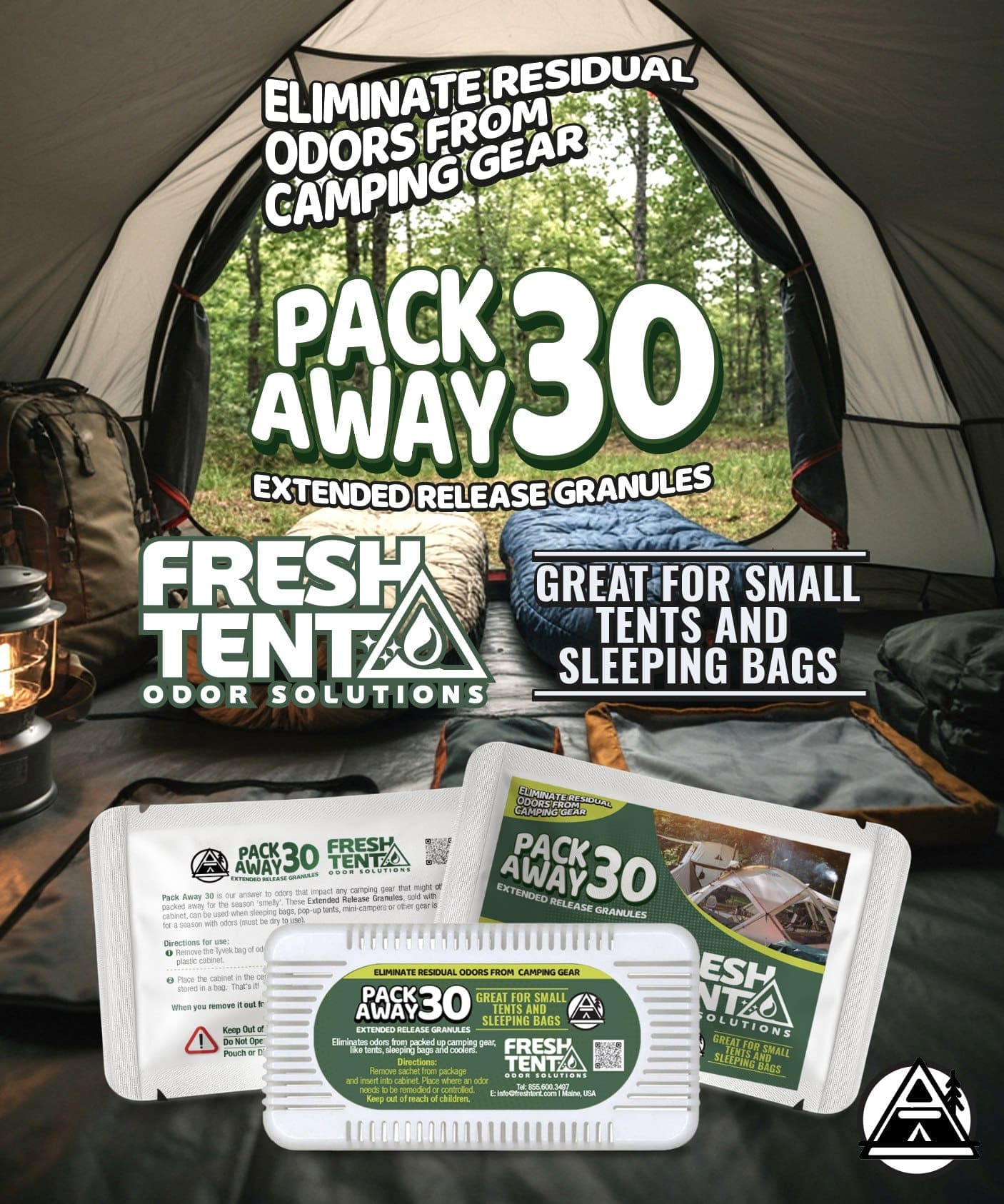
Pack-Away 30 → small tent bags, sleeping bags, coolers.
-
Stow-Away 60 → larger gear bins or multi-month storage.
Placed inside the storage environment, they:
- Maintain treated airspace.
- Interrupt recontamination cycles.
- Prevent buildup rather than chasing odor later.
The Authority Perspective
There are three categories of odor control:
-
Masking → smells better temporarily.
-
Absorbing → holds odor until saturated.
-
Oxidizing → chemically alters odor molecules.
Only the third category neutralizes at the molecular level.
3 Frequently Asked Questions on Camping Gear Odor Removal
1. Is activated charcoal enough for tent storage?
It may reduce mild odor but does not neutralize sulfur-based or microbial VOC compounds during long-term storage.
2. Is ozone stronger than chlorine dioxide?
Ozone is more aggressive but impractical for seasonal passive storage and can damage materials.
3. Why not just air gear out before using it?
Airing out reduces concentration temporarily but does not break down absorbed molecular compounds.