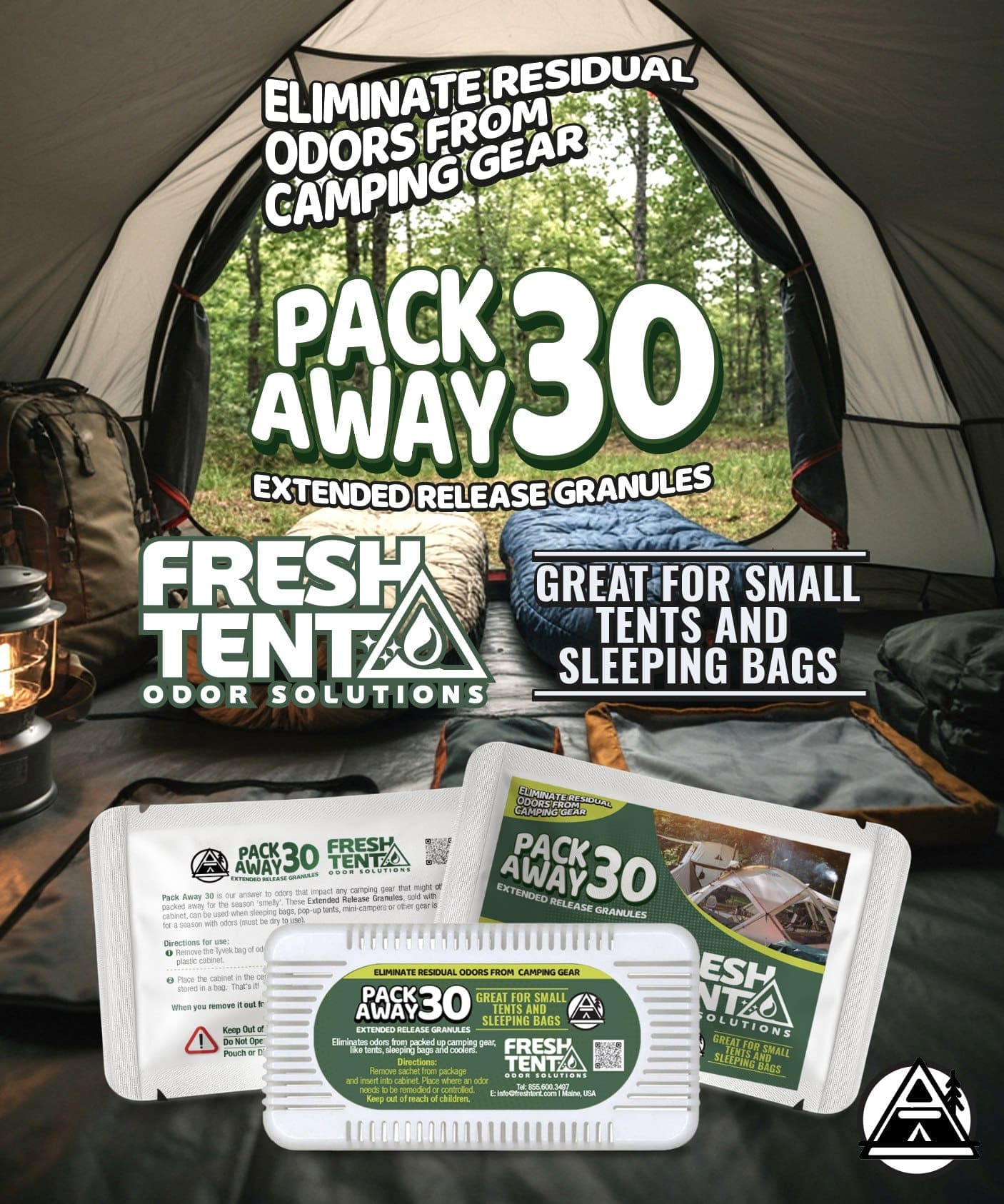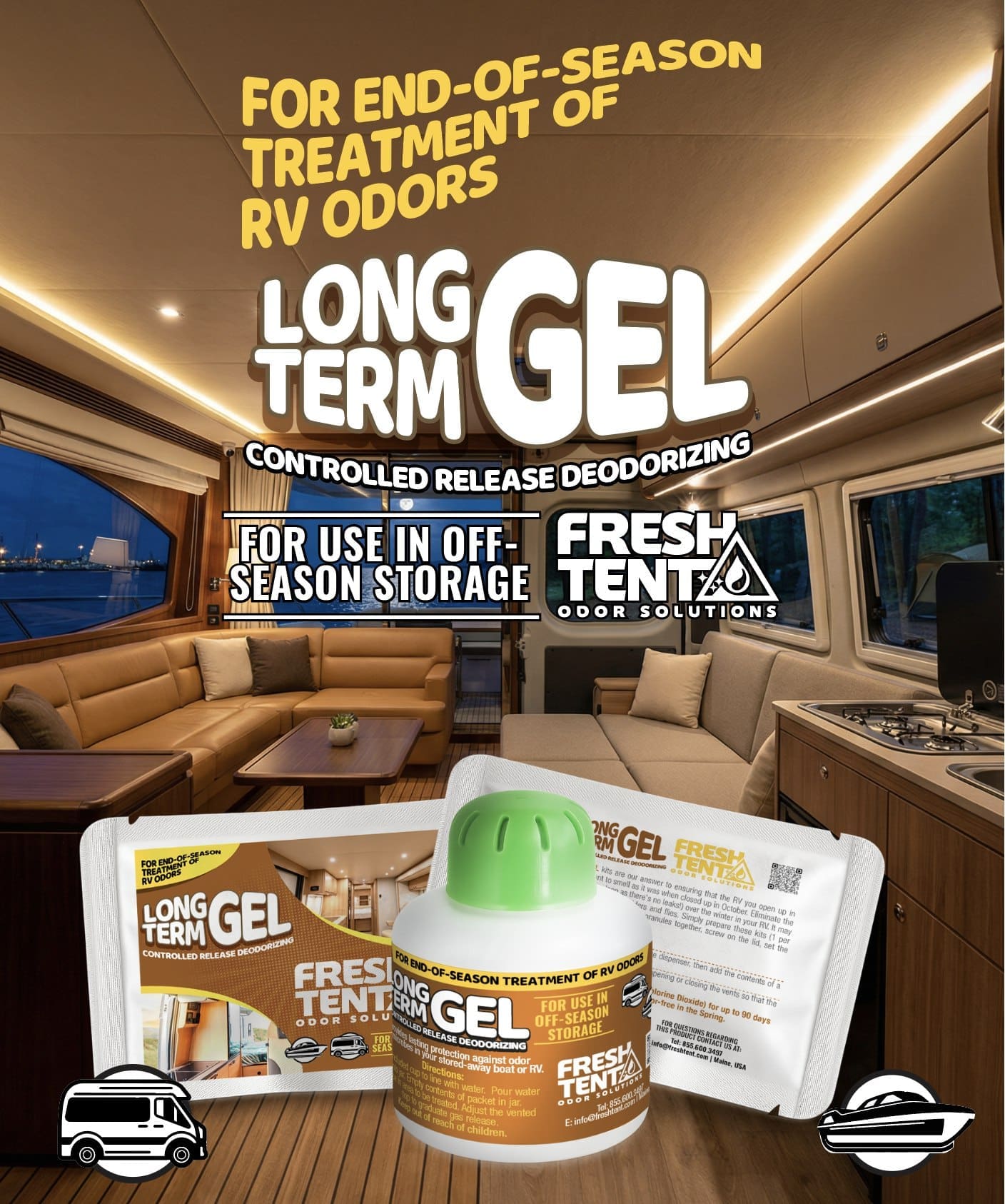
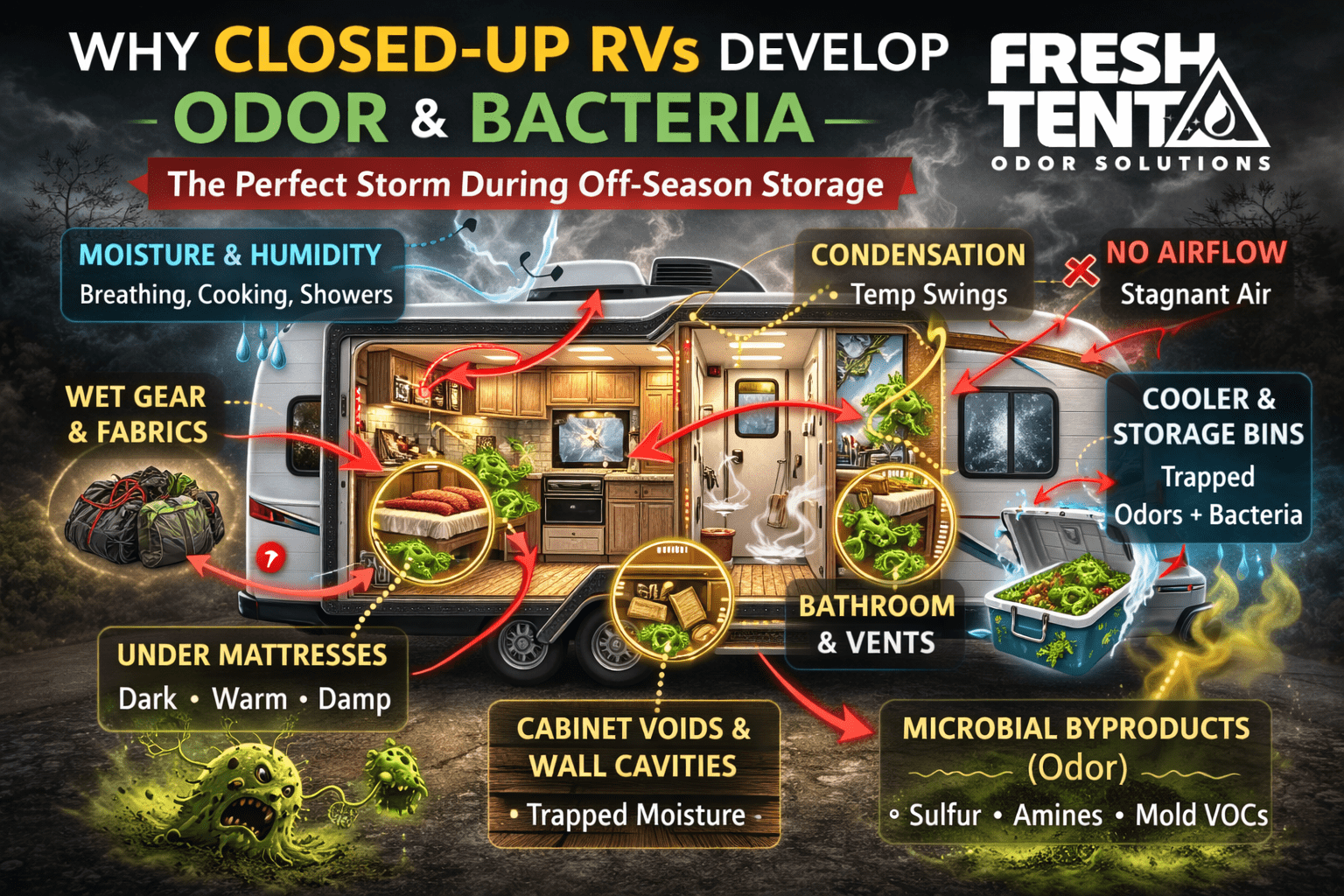
Even when mold isn’t visible, humidity allows microbial growth inside wall cavities, cushions, and storage areas. These microbes release odor-causing gases. Chlorine dioxide neutralizes these airborne compounds before they accumulate. Moisture inside campers fuels microbial odor production — even when you don’t see mold. Here’s how airborne chlorine dioxide interrupts the cycle.
Why Campers Are High-Risk Microbial Environments
RVs, trailers, and campers are uniquely vulnerable to odor development — not because they are dirty, but because of how they are built and used.
Unlike homes, campers are:
- Small, tightly enclosed structures
- Built with lightweight composite materials
- Exposed to dramatic temperature fluctuations
- Frequently sealed for long periods
- Used in high-moisture recreational settings
This combination creates a near-perfect environment for microbial growth.
1. Confined Air Volume
In a typical RV, the total air volume may be only a few hundred cubic feet. That means:
- Odor molecules concentrate faster
- Air exchange is limited
- Contaminants recirculate rather than dissipate
When ventilation stops, the air essentially becomes a closed system.
2. Repeated Moisture Loading
Camping introduces moisture from multiple sources:
- Cooking steam
- Breathing (each person exhales significant water vapor overnight)
- Wet shoes and gear
- Showers and sink use
- Condensation from temperature swings
Even when surfaces feel dry, relative humidity inside cushions, wall cavities, and storage compartments can remain elevated.
3. Hidden Microclimates
Campers contain dozens of small, low-airflow pockets:
- Under mattresses
- Inside cabinet voids
- Beneath bench seating
- In bathroom wall cavities
- Inside cooler lids and storage bins
These areas:
- Stay dark
- Retain warmth
- Trap moisture
- Receive little ventilation
That combination supports microbial colonization.
Importantly: visible mold is not required for odor production.
The Microbial Odor Mechanism (What’s Actually Causing the Smell)
Microorganisms do not smell — their metabolic byproducts do.
When bacteria and fungi digest organic material (dust, skin cells, food residue, fabric fibers), they release volatile compounds into the air.
Common odor-causing emissions include:
-
Sulfur compounds (rotten or sour notes)
-
Amines (fishy or stale smell)
-
Organic acids (sharp or acidic odor)
-
Ketones and aldehydes
-
Microbial volatile organic compounds (mVOCs)
These molecules:
- Are extremely small
- Travel easily through air
- Re-circulate in confined spaces
- Absorb into fabrics and soft materials
This is why a camper can smell musty even when it looks clean.
Surface wiping does not remove airborne molecular contamination.

The Recirculation Problem in Stored Campers
Once sealed for storage, a camper becomes a closed chemical system:
- Microbes continue slow metabolic activity.
- Odor molecules accumulate in stagnant air.
- Fabrics and porous materials absorb those molecules.
- When temperatures rise, absorbed odors re-release.
This cycle explains why:
- The smell seems stronger when first opened
- It returns quickly after airing out
- It reappears season after season
Unless the airborne molecules are neutralized, the cycle continues.
Why Continuous Low-Level Treatment Matters
Many people attempt:
- Ozone shock treatments
- Heavy fragrance sprays
- Occasional ventilation
These approaches may temporarily reduce odor, but they do not provide ongoing control during storage.
What’s required in a sealed environment is:
- Continuous, controlled oxidation
- Low, steady gas-phase treatment
- Safe concentration levels
- No masking fragrance
- No electrical requirement
In other words: the air itself must be treated while the camper sits unused.

Why Chlorine Dioxide Works in This Application
Chlorine dioxide (ClO₂) functions as a selective oxidizer in gas form.
At controlled low levels, it:
- Disperses throughout enclosed airspace
- Reaches hidden compartments
- Oxidizes sulfur and amine compounds
- Breaks molecular bonds responsible for odor
- Interrupts the microbial odor cycle
Because it works in the air phase, it addresses:
- Airborne molecules
- Compounds released from hidden spaces
- Odors re-emitted from fabrics
This is fundamentally different from masking agents or surface cleaners.
Best Solution for Seasonal Storage
Recommended: Stow-Away 60 or Stow-Away 90
These products are designed specifically for long-term enclosed storage conditions.
They:
- Provide 60–90 days of controlled release
- Maintain low-level air treatment
- Require no power
- Operate passively inside sealed compartments
- Help prevent odor buildup during inactivity
Choose based on expected storage duration:
- 60 days → mid-season storage
- 90 days → full off-season layup
Practical Application for Off-Season RV Storage
For best results:
- Clean and dry interior surfaces.
- Remove obvious moisture sources.
- Allow camper to air out before sealing.
- Place Stow-Away unit centrally in main cabin or storage compartment.
- Close and seal RV as normal.
The product then maintains controlled atmospheric treatment while the unit is in storage.
When opened in spring, the air remains neutral rather than stale.