
The Short Answer: Yes — and It’s the Smart Way to Do It
Most RV and camper owners treat odor removal as a reactive chore—something dealt with only after opening the door months later. The reality is this:
Odors don’t appear suddenly. They develop slowly during storage.
That means storage time is the best opportunity to stop odors before they form.
Why RV Odors Get Worse During Storage
When an RV or camper is parked and sealed, several things happen simultaneously:
1. Residual Moisture Becomes Trapped
- Humidity lingers in cushions, carpets, and wall panels
- Small leaks or condensation accelerate microbial growth
2. Organic Residue Keeps Breaking Down
- Food vapors, body oils, pet dander, and cooking residue remain active
- Bacteria continue metabolizing this residue—even in the dark
3. Airflow Stops Completely
- No ventilation means gases and odors concentrate rather than dissipate
Result: The RV smells worse because it was stored, not despite it.
The Key Insight: Odor Prevention Is Easier Than Odor Removal
Odors are not just “bad air.” They are volatile gas molecules released as bacteria break down organic material.
If you stop that process during storage, you:
- Prevent odor buildup
- Reduce surface contamination
- Avoid aggressive cleaning later
This is why deodorizing during storage is both simpler and more effective.
How to Rid Odors While Your RV Is in Storage
Step 1: Clean Before You Close the Door
Before storage, wipe down:
- Kitchen surfaces
- Bathroom fixtures
- Floors and high-touch areas
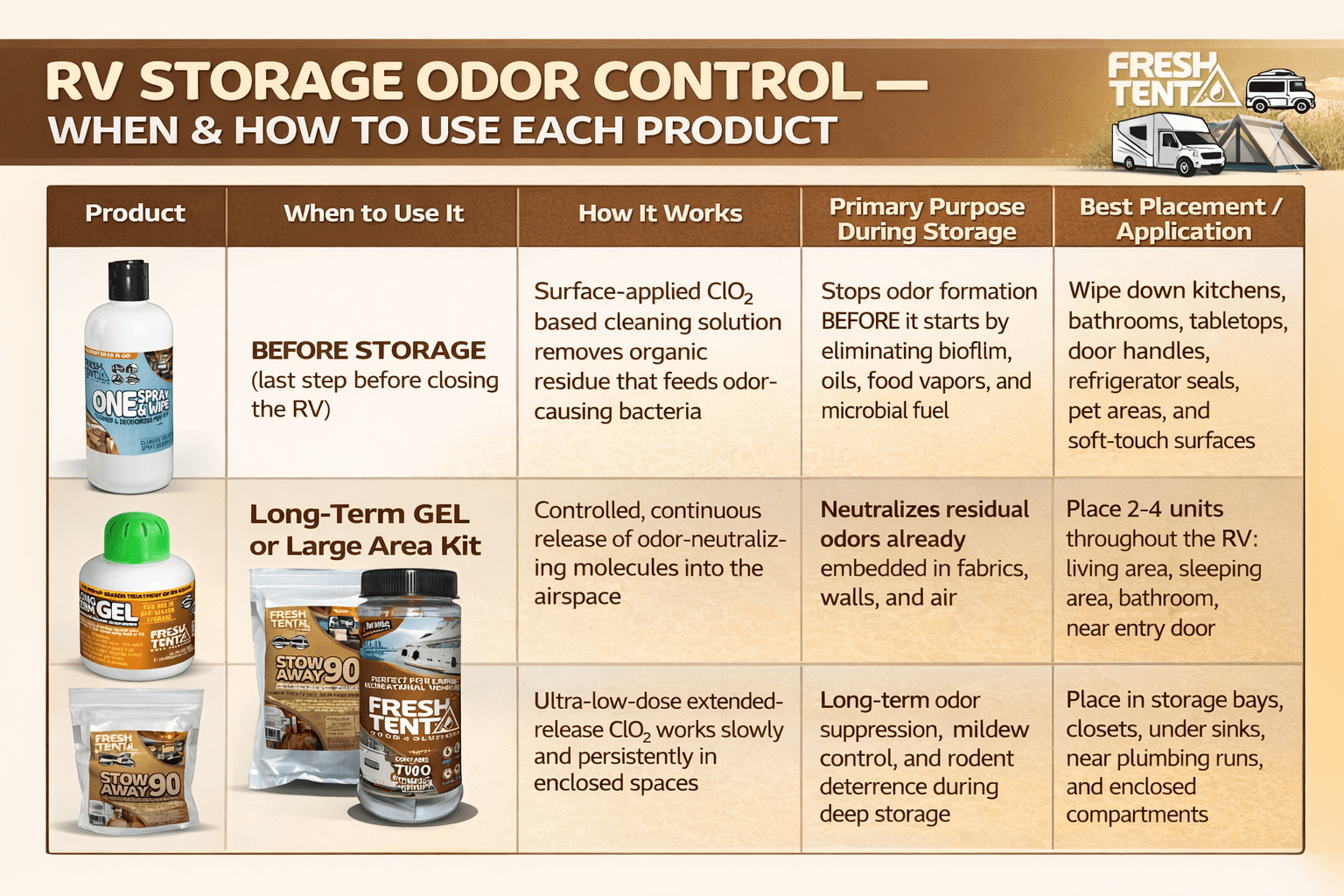
This removes the organic fuel odors need to form. This is best performed with our ONE Spray & Wipe Cleaner, Deodorizer & Sanitizer.
Step 2: Use a Storage-Active Deodorizing System
Unlike sprays that work once and disappear, storage requires:
- Continuous odor molecule neutralization
- Moisture-tolerant performance
- No electricity or airflow
This is where FreshTent Gel Air Purifying Kits and Stow-Away systems excel—they work quietly and continuously while the RV sits unused.
Step 3: Target High-Risk Zones
Place odor-control products:
- Near bathrooms and holding tanks
- In sleeping areas and closets
- Near entry points where moisture and pests enter
A good choice for these storage applications would be our FreshTent STOW-AWAY 90 Granule Pouches.
What About Rodents, Musty Smells, and “Closed-Up” Odor?
Long-term storage odors often overlap with:
- Rodent intrusion
- Damp, moldy smells
- Plastic and vinyl off-gassing
A properly placed long-term deodorizing system:
- Deters animals sensitive to clean-air chemistry
- Reduces musty odors without masking
- Keeps the interior smelling neutral—not perfumed
This too is a perfect application for our FreshTent STOW-AWAY 90 Granule Pouches. Here is a handy chart that will sum it all up.
What Not to Do During Storage
Avoid these common mistakes:
- ❌ Leaving baking soda or charcoal scattered around
- ❌ Using scented air fresheners (they fade, then sour)
- ❌ Sealing odors inside without neutralizing them
These methods absorb or cover odors temporarily—but do not stop odor production.
The Payoff: Open the Door to a Clean-Smelling RV
When you deodorize during storage:
- No “first-day cleanup”
- No shock odors when reopening
- Less deep cleaning before travel
You store your RV once—and retrieve it ready to use.
Bottom Line
Yes, you can absolutely store your RV or camper and rid odors at the same time. In fact, that’s the most effective moment to do it.
Odor control during storage isn’t about masking smells—it’s about stopping them before they exist.
Looking for More Answers?
Q: Can I deodorize my RV while it’s in storage?
Yes. Continuous deodorizing systems work while your RV is parked, preventing odor formation during storage.
Q: Why does my RV smell worse after storage?
Because trapped moisture and organic residue allow bacteria to keep producing odor gases in a sealed environment.
Q: Are air fresheners effective during RV storage?
No. They fade quickly and do not stop the biological processes that create odors.