
Why Camping Odors Are Harder to Eliminate
Odor control in tents, RVs, boats, and cabins is uniquely challenging because these spaces are:
- Small and enclosed
- Often damp or humid
- Filled with fabrics and porous materials
- Poorly ventilated when stored
Unlike outdoor odors that disperse naturally, camping odors tend to build up, recycle, and intensify over time. To eliminate them effectively, it’s critical to understand where odors actually live.
Odors on Surfaces vs. Odors in the Air
Odors fall into two distinct categories:
Surface-Based Odors (The Source)
Surface odors originate from:
- Food residue and spills
- Body oils absorbed into fabrics
- Pet dander and hair
- Mold, mildew, and bacteria
These sources continuously release odor-causing gases. As long as residue remains, odors will return — even if the air smells temporarily better.
Airborne Odors (The Symptom)
Airborne odors are already-released gases:
- Cooking smells
- Musty, stagnant air
- Smoke and fuel odors
- General “closed-up” RV or tent smell
Airborne odors can move, settle, and penetrate materials, making them harder to eliminate without treating the entire space.
How ONE Spray & Wipe Eliminates Surface Odors
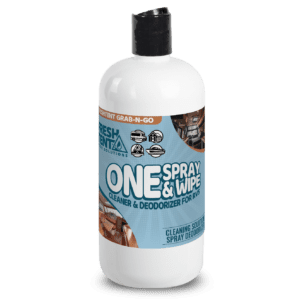
ONE Spray & Wipe is designed to clean and neutralize odors at their origin.
What It Does
- Breaks down organic residue on contact
- Neutralizes odor-causing bacteria
- Cleans without perfumes or masking agents
Where It Excels
- Tent floors, walls, and gear bins
- RV counters, tables, bathrooms, and kitchens
- Coolers, trash areas, and food prep surfaces
- Sleeping pads, pet areas, and frequently touched zones
This step is essential because air treatments alone cannot remove residue. Without surface cleaning, odors will continue to off-gas.
How the Large Area Deodorizing Kit Treats Air and Space
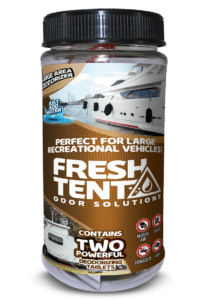
The Large Area Deodorizing Kit works differently — and complements surface cleaning rather than replacing it.
What It Does
- Releases low-level chlorine dioxide (ClO₂) gas
- Neutralizes airborne odor molecules
- Penetrates fabrics, cushions, and hidden spaces
- Continues working in closed environments
Where It Excels
- Closed-up RVs and campers
- Cabins between guests or seasons
- Tents or gear rooms with persistent mustiness
- Situations where ventilation is limited
Unlike sprays, the gas disperses evenly, reaching places that wipes and liquids cannot.
Why Surface Cleaning and Air Treatment Must Work Together
Using only one approach often leads to disappointment:
- Air-only treatment: smells better temporarily, but odors return
- Surface-only cleaning: improves hygiene, but lingering air odors remain
Best Practice for Camping Spaces
- Clean first with ONE Spray & Wipe to remove odor sources
- Then treat the airspace using the Large Area Deodorizing Kit
- Allow time for complete molecular neutralization
This two-step process results in true odor removal, not masking. Here is a large, but wonderful chart detailing the application of each product.

Why Masking Odors Fails in Camping Environments
Traditional odor solutions — air fresheners, essential oils, scented cleaners — simply add competing smells. In enclosed camping spaces, this often:
- Intensifies unpleasant combinations
- Triggers headaches or sensitivities
- Leaves odors trapped in fabrics
FreshTent products eliminate odor molecules instead of covering them up.
When to Use Each Product (Quick Guide)
- Daily cleaning & spot odors → ONE Spray & Wipe
- Persistent or whole-space odors → Large Area Deodorizing Kit
- Seasonal storage or turnover → Use both together
Practical Takeaway
Removing odors from the air is different than removing them from surfaces — and effective camping odor control requires both. ONE Spray & Wipe eliminates the source, while the Large Area Deodorizing Kit resets the air and space. Together, they keep tents, RVs, and cabins fresh long after the trip ends.