
The Problem with “Spray-and-Pray” Odor Control
For decades, odor sprays have trained consumers to expect a quick sensory fix: spray, smell something pleasant, and assume the odor is gone. In reality, most spray deodorizers do not remove odors at all. They temporarily overpower them—often while introducing new problems into enclosed spaces like RVs, tents, cabins, and boats.
FreshTent products take a fundamentally different approach by targeting odors at the molecular level, rather than covering them up.
To understand why sprays fall short, we need to look at what’s actually inside them.
VOC Propellants: Air Pollution You Spray Indoors
Most aerosol and pump sprays rely on volatile organic compounds (VOCs) to disperse fragrance.
Why VOCs Are a Problem
- VOCs evaporate rapidly, contributing to indoor air pollution
- They react with ozone and other compounds to create secondary pollutants
- In confined spaces, VOC levels can exceed outdoor air quality standards
Even “pump” sprays labeled as non-aerosol often rely on solvents that behave similarly once airborne.
FreshTent products avoid VOC-based delivery entirely by using controlled-release chlorine dioxide (ClO₂), which disperses evenly through air without introducing hydrocarbon propellants.
Heavier-Than-Air Droplets: Why Sprays Miss the Odor Source
Spray droplets are heavier than air. That means they fall quickly—coating floors, fabrics, and surfaces—while many odor molecules remain suspended in the air or trapped deep within porous materials.
What Happens Instead
- Droplets settle before reaching odor reservoirs
- Odors trapped in foam, fabrics, and crevices remain untouched
- Moisture from sprays can actually feed odor-causing microbes
FreshTent’s gas-phase technology moves with the air, not against gravity, allowing it to penetrate where sprays physically cannot.
Oily Fragrances: Residue That Traps Odors Over Time
That lingering “fresh” smell after spraying? It’s usually oil-based fragrance.
The Hidden Cost of Fragrance Oils
- Oils cling to fabrics, walls, and plastics
- Residue becomes a magnet for new odors
- Heat and humidity re-activate old fragrance layers, creating sour or mixed smells
This is why spaces treated repeatedly with sprays often develop a permanent underlying odor.
FreshTent products do not rely on fragrance oils. Odors are neutralized, not perfumed—leaving nothing behind to trap future smells.
Allergy & Sensitivity Triggers in Common Sprays
Many spray deodorizers contain ingredients linked to irritation and sensitivity reactions.
Common Triggers Include:
- Synthetic musks
- Phthalates (used to make fragrance last longer)
- Alcohols and solvents
- Preservatives designed for liquid shelf stability
These ingredients are especially problematic in small enclosed environments where ventilation is limited.
FreshTent products are designed to work without masking agents, reducing the risk of respiratory irritation and fragrance overload.
Masking vs. Molecular Neutralization: The Real Difference
| Spray Deodorizers | FreshTent Products |
|---|---|
| Mask odor with fragrance | Neutralize odor molecules |
| Leave residues | Leave no residue |
| Fall out of air | Travel through air |
| Short-term effect | Long-lasting control |
| Add VOCs | No hydrocarbon propellants |
FreshTent’s chlorine dioxide technology works by altering odor molecules themselves, rendering them odorless instead of hiding them.
When Sprays Still Have a Role (and When They Don’t)
Sprays may be useful for surface cleaning or quick wipe-downs when paired with proper chemistry—such as FreshTent’s ONE Spray & Wipe, which is formulated to clean and sanitize without heavy fragrance.
But for:
- Stored RVs
- Seasonal cabins
- Tents and gear
- Boats and closed spaces
…sprays alone are simply the wrong tool.
The FreshTent Advantage: Odor Control That Actually Lasts
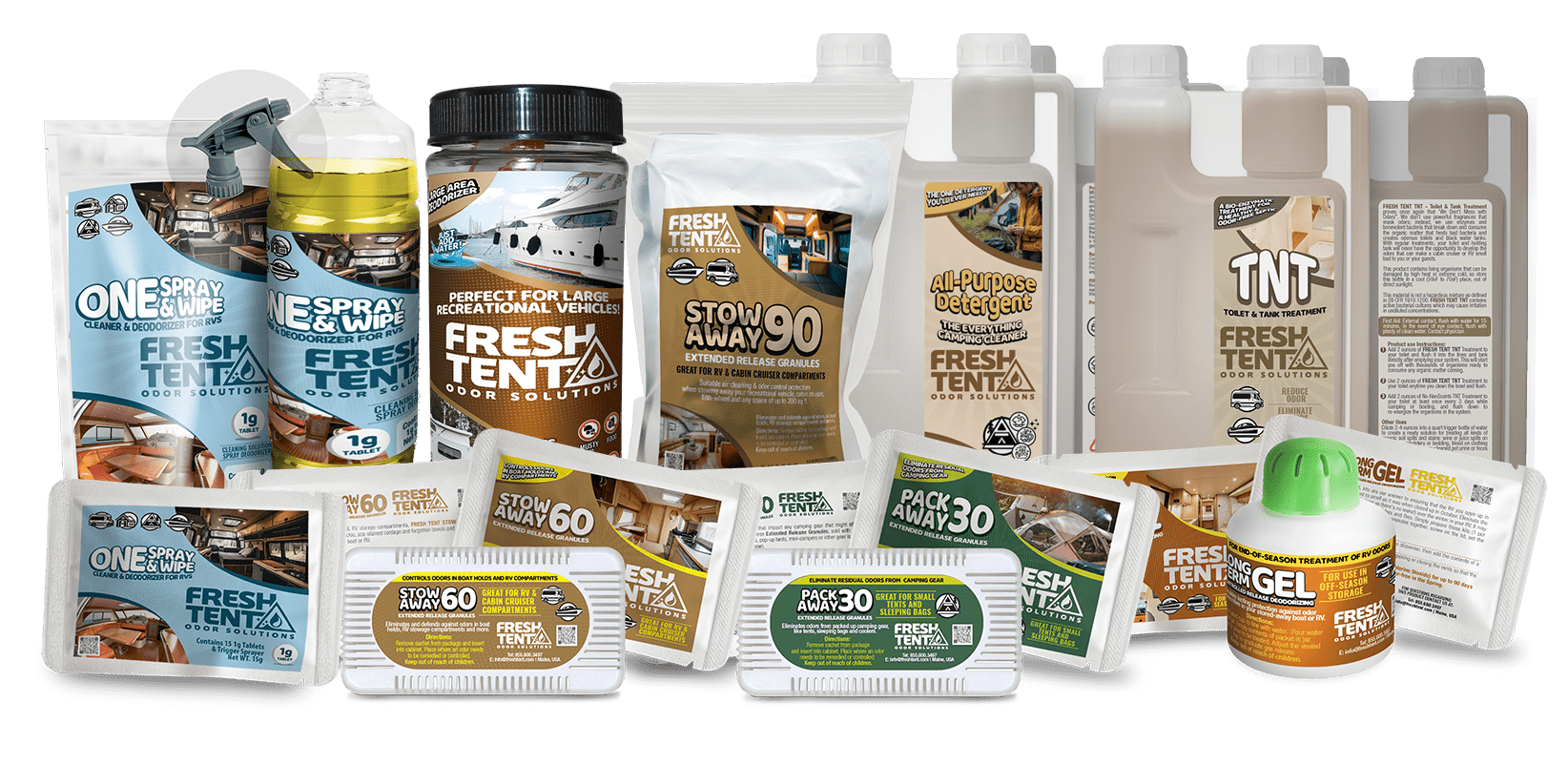
FreshTent products are designed for:
- Whole-space deodorization
- Off-season storage
- Continuous low-dose odor control
- No masking, no residue, no fragrance overload
By working in the same phase as odors—air—FreshTent eliminates the root cause rather than distracting your nose.
More Related Frequently-Asked-Questions:
1. Do spray deodorizers remove odor molecules?
No. Most sprays mask odors with fragrance rather than neutralizing the odor-causing compounds.
2. Why do odors come back after spraying?
Because the source was never removed—only temporarily covered.
3. Are VOCs dangerous in enclosed spaces?
In high concentrations, VOCs can contribute to respiratory irritation and poor indoor air quality.
4. Is fragrance-free odor control more effective?
Yes, when it relies on molecular neutralization rather than masking.